

If you are researching ProDentim natural ingredients because you want to understand what is actually inside the product, the most useful place to start is not a promotional headline. It is the current Supplement Facts label.
The YouTube video “PRODENTIM NATURAL INGREDIENT” highlights interest around the formula and its natural-ingredient positioning. This guide takes a careful, consumer-focused approach by separating ingredient information from marketing claims and explaining what buyers should check before relying on any oral-health supplement.
Watch directly on YouTube: PRODENTIM NATURAL INGREDIENT
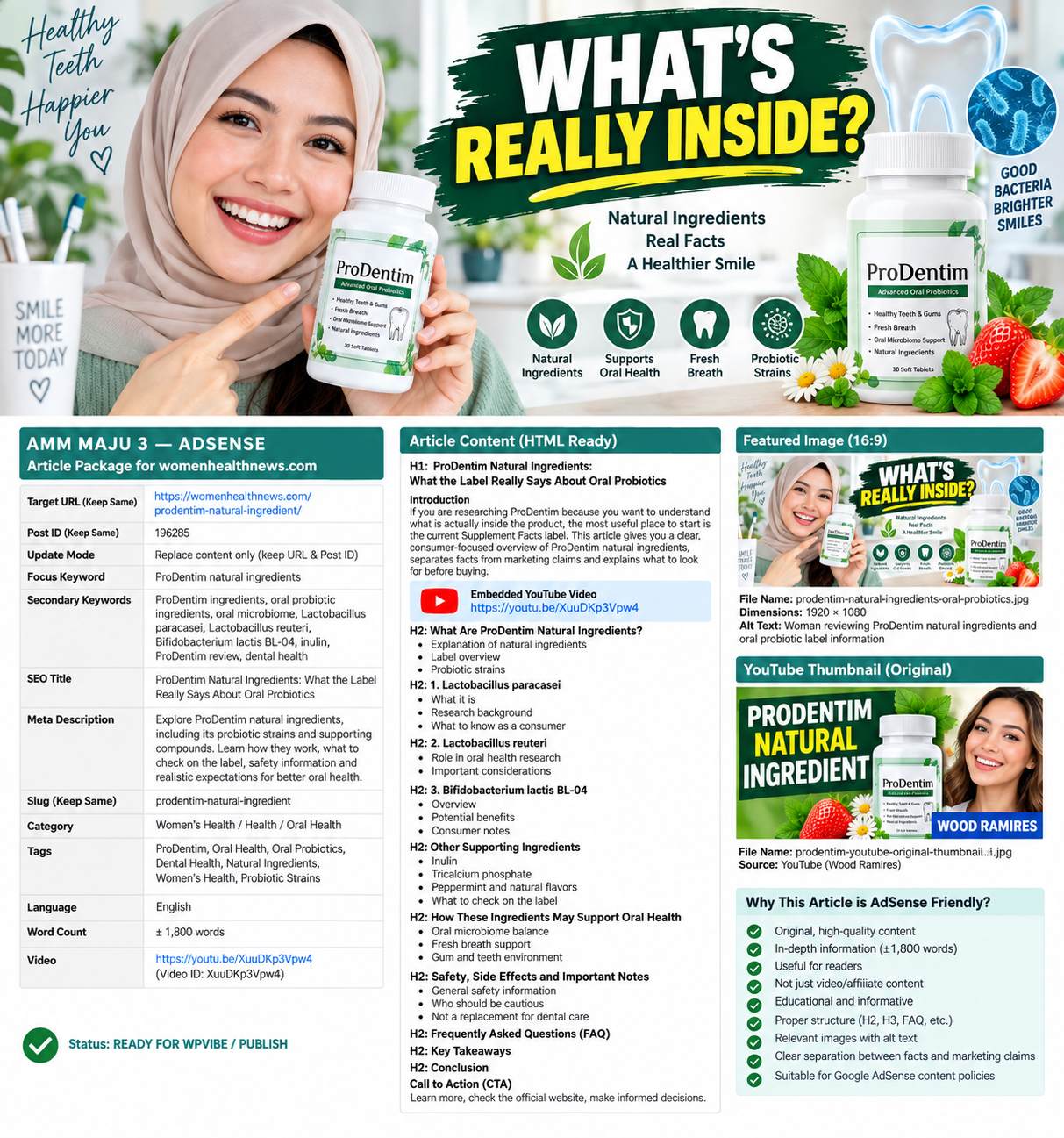
ProDentim is commonly presented as an oral probiotic supplement. Current label references commonly identify three probiotic organisms in a proprietary probiotic blend: Lactobacillus paracasei, Lactobacillus reuteri and Bifidobacterium lactis BL-04. Some product materials also list inulin and other supporting ingredients. Because supplement formulas can change, consumers should always compare any online description with the physical label on the bottle they actually receive.
What Are ProDentim Natural Ingredients?
The phrase “natural ingredients” can sound reassuring, but it is still important to look at the exact label. A product can contain naturally derived ingredients while also containing processing aids, flavoring agents, sweeteners or other inactive ingredients.
Current label references for ProDentim commonly identify a probiotic blend built around three organisms:
- Lactobacillus paracasei
- Lactobacillus reuteri
- Bifidobacterium lactis BL-04
Some current label and product references also mention supporting ingredients such as inulin, tricalcium phosphate, peppermint and flavoring components. The exact formula should be checked against the latest product label because different listings, sellers or product versions may not always match.
1. Lactobacillus paracasei
Lactobacillus paracasei is a probiotic organism used in a variety of dietary supplements. It has also been studied in relation to microbial balance in the mouth and other parts of the body.
For consumers, the important distinction is this: evidence about an individual probiotic strain does not automatically prove that a finished commercial product will produce the same outcome. Benefits can depend on the exact strain, dose, storage conditions, product quality and the individual using it.
When reading a supplement label, check whether the manufacturer identifies the probiotic at strain level rather than only naming the species.
2. Lactobacillus reuteri
Lactobacillus reuteri is another probiotic organism that appears in oral-probiotic research. Studies on specific strains have explored areas such as gum health, microbial balance and oral-care support.
However, a supplement should not be treated as a replacement for brushing, flossing, routine dental examinations or professional treatment for gum disease, cavities or oral infections.
A useful question to ask is whether the evidence being quoted refers to the exact strain and dose used in the product or only to the broader Lactobacillus reuteri species.
3. Bifidobacterium lactis BL-04
Bifidobacterium lactis BL-04 is another named probiotic found in current ProDentim label references. Bifidobacteria are widely used in probiotic products, and BL-04 has appeared in research involving immune and respiratory-related outcomes.
That does not mean every oral-health claim made around a commercial supplement has been clinically proven. Product-specific evidence matters. Consumers should distinguish between studies on an isolated ingredient and controlled clinical trials on the final product.
4. Inulin as a Prebiotic Ingredient
Inulin is a type of prebiotic fiber. Prebiotics act as food substrates for certain beneficial microorganisms. That is why probiotic and prebiotic ingredients are sometimes combined in the same formulation.
In some current ProDentim references, inulin is listed as a supporting ingredient. Anyone with digestive sensitivity should remember that prebiotic fibers can sometimes cause gas, bloating or gastrointestinal discomfort in susceptible individuals.
5. Tricalcium Phosphate
Tricalcium phosphate is a calcium-containing compound used in foods, supplements and dental-related formulations. Calcium and phosphate are naturally relevant to teeth and bones, but the presence of a mineral ingredient in a supplement should not be interpreted as proof that the product can rebuild enamel or treat dental disease.
Claims about enamel repair, cavity reversal or treatment should be supported by appropriate clinical evidence rather than inferred from the ingredient name alone.
6. Peppermint and Flavoring Ingredients
Peppermint is commonly used for flavor and a fresh-mouth sensation. It can make a chewable oral supplement more pleasant to take, but freshness after use should not be confused with treatment for persistent bad breath.
Ongoing halitosis can sometimes be linked to gum disease, cavities, dry mouth, smoking, diet, medication effects or other health conditions. Persistent symptoms deserve professional dental or medical assessment.
What Does “3.5 Billion CFU” Mean?
Some current label references state that the probiotic blend is formulated with 3.5 billion CFU at the time of manufacture. CFU means colony-forming units, a conventional way of expressing the quantity of viable microorganisms in probiotic products.
Consumers should pay attention to the wording “at the time of manufacture.” Probiotic viability can be influenced by time, temperature, moisture and storage conditions. If the product label provides storage instructions, follow them carefully.
Proprietary Blend: What Consumers Should Know
A proprietary blend groups multiple ingredients together under one total quantity instead of always stating the individual amount of every ingredient. This does not automatically mean the product is unsafe. However, it can reduce transparency because consumers may not be able to tell how much of each individual ingredient is present.
Before buying any supplement, ask:
- Are all active ingredients clearly identified?
- Are individual doses disclosed?
- Is the probiotic strain identified precisely?
- Is the CFU amount guaranteed through expiry or only at manufacture?
- Are there allergen statements?
- Are storage instructions provided?
- Is there independent testing documentation?
Natural Does Not Automatically Mean Risk-Free
The word “natural” is not the same as “risk-free.” Probiotics are generally well tolerated by many healthy adults, but supplements can still cause side effects or create concerns for some people.
People who are pregnant or breastfeeding, immunocompromised, receiving medical treatment, taking prescription medicines, preparing for surgery or managing chronic medical conditions should discuss supplement use with a qualified healthcare professional.
The same applies if you have significant gum disease, dental pain, swelling, bleeding, loose teeth or signs of infection. Supplements should not delay professional dental care.
Can ProDentim Replace Brushing and Flossing?
No oral probiotic supplement should replace the foundations of dental care. A strong oral-health routine still includes:
- Brushing twice daily with appropriate toothpaste
- Cleaning between teeth with floss or interdental tools
- Limiting frequent sugary snacks and drinks
- Drinking adequate water
- Avoiding tobacco
- Attending dental check-ups based on individual need
- Seeking treatment for pain, bleeding gums, cavities or infection
Supplements, when used, should be considered an optional addition rather than the foundation of oral care.
What Women Should Consider Before Using an Oral Supplement
Women may encounter different oral-health challenges at different life stages. Hormonal changes during pregnancy, menstruation and menopause can influence gum sensitivity, dry mouth and oral comfort in some people.
That makes professional dental guidance especially valuable when symptoms are persistent. A supplement may be part of a personal wellness routine, but it should not replace diagnosis or treatment.
Pregnant or breastfeeding women should check with a healthcare professional before introducing a new dietary supplement, particularly if the full ingredient profile, dosage or safety data are unclear.
How to Evaluate ProDentim Claims Before Buying
Instead of relying on testimonials alone, use a simple evidence checklist.
Check the Physical Label
Online sales pages can become outdated. The bottle label is the most relevant source for the formula you actually receive.
Separate Ingredient Research from Product Research
A study on Lactobacillus reuteri is not automatically a study on ProDentim. Look for research on the finished product at the marketed dose.
Look for Precise Strain Information
Probiotic effects can be strain-specific. The more precise the label, the easier it is to compare the product with published research.
Be Cautious with Absolute Claims
Statements such as “cures gum disease,” “rebuilds teeth,” “eliminates cavities” or “works for everyone” should be treated cautiously unless supported by robust clinical evidence and appropriate regulatory authorization.
Check Seller Authenticity
Supplements sold through multiple websites can create confusion over formulation, storage and authenticity. Compare packaging carefully and use established purchasing channels.
Possible Side Effects and Practical Cautions
Probiotic and prebiotic supplements can sometimes cause temporary digestive symptoms such as gas, bloating or changes in bowel habits. Allergic reactions are possible with any product depending on its ingredients.
Stop using a supplement and seek appropriate medical care if you experience a serious or unexpected reaction.
For dental symptoms such as severe toothache, facial swelling, fever, pus, persistent bleeding or rapidly worsening gum problems, seek professional dental care rather than relying on a supplement.
Key Takeaways
- ProDentim is marketed as an oral probiotic supplement.
- Current label references commonly list Lactobacillus paracasei, Lactobacillus reuteri and Bifidobacterium lactis BL-04.
- Supporting ingredients can vary by product version, so always check the latest physical label.
- Ingredient-level research is not the same as clinical proof for the finished product.
- A proprietary blend can make individual ingredient quantities harder to evaluate.
- “Natural” does not mean risk-free or medically proven.
- Oral probiotics should not replace brushing, flossing, dental examinations or treatment.
- Pregnant, breastfeeding or medically vulnerable consumers should discuss supplement use with a healthcare professional.
Frequently Asked Questions
What are the main ProDentim probiotic ingredients?
Current label references commonly identify Lactobacillus paracasei, Lactobacillus reuteri and Bifidobacterium lactis BL-04 in the probiotic blend. Check your own bottle because formulations can change.
Is ProDentim completely natural?
Marketing may describe the formula as natural, but consumers should review the complete active and inactive ingredient list rather than relying on the word “natural” alone.
Does ProDentim cure gum disease?
A dietary supplement should not be treated as a cure for gum disease. Gum disease requires appropriate dental assessment and treatment.
Can oral probiotics improve the oral microbiome?
Specific probiotic strains are being studied for oral-health applications, but results depend on strain, dose and the clinical context. Research on an ingredient does not automatically establish the effectiveness of a specific commercial product.
Is 3.5 billion CFU a high dose?
CFU numbers alone do not determine quality or effectiveness. Strain identity, viability, storage, dosage and clinical evidence also matter.
Can I take ProDentim during pregnancy?
Pregnant or breastfeeding women should consult their healthcare professional before starting a new supplement.
Does ProDentim replace toothpaste or dental visits?
No. Supplements do not replace brushing, interdental cleaning or professional dental care.
What is the best way to verify ProDentim ingredients?
Check the current Supplement Facts panel on the bottle you receive and compare it with reliable product-label databases or manufacturer documentation.
Conclusion
ProDentim’s natural-ingredient message is easy to understand, but a careful consumer should go one step further and examine the exact label, strain information, CFU wording, supporting ingredients and evidence behind each claim.
The most useful approach is not to ask whether one ingredient sounds impressive. Ask whether the finished product is transparent, whether its claims match the evidence and whether it fits safely into an established oral-care routine.
If you are interested in the original video that inspired this guide, watch “PRODENTIM NATURAL INGREDIENT” on YouTube.
